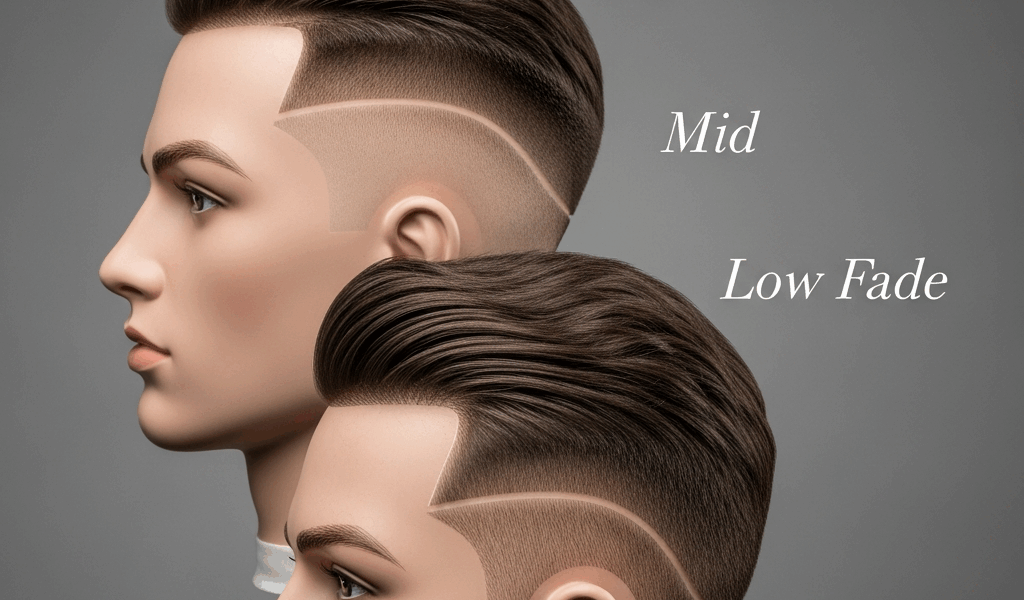
High Fade vs Mid Fade vs Low Fade — Which One Actually Suits Your Face
Fade haircuts have gotten complicated with all the Instagram screenshots and barbershop jargon flying around. As someone who’s been behind the chair for eleven years — the last six running my own shop in Chicago — I learned everything there is to know about what makes a fade work and, more importantly, what makes it fail. I get asked the high-vs-mid-vs-low question four or five times a day, easy. And almost every guy asking it has already screenshot a photo of someone with a completely different face shape. That’s fine. But that’s also exactly where things go sideways.
This article includes affiliate links. We may earn a commission at no extra cost to you.
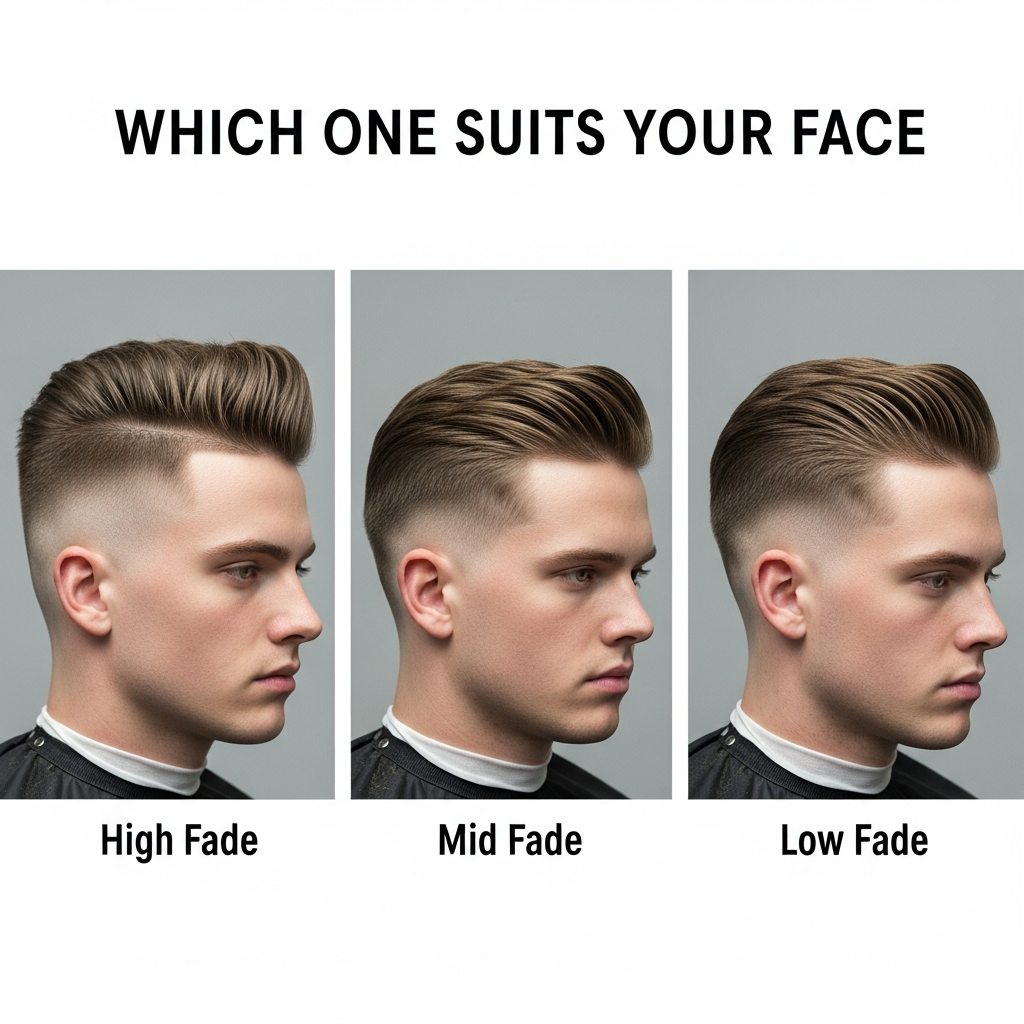
So here’s the real breakdown — not the fluffy “all fades look great on everyone” version, because that helps nobody.
Low, Mid, and High Fade — Where Each One Actually Starts
But what is a fade, really? In essence, it’s a gradual transition from shorter hair near the skin up to longer hair on top. But it’s much more than that — the starting point of that transition changes the entire silhouette of your head, and most guys don’t realize there are three completely distinct options before they sit down.
The Low Fade
A low fade starts just above the ear and around the back of the neck — roughly an inch above your natural hairline. The skin or short graduation kicks in right there and blends upward. From across a room, it can almost pass for a natural taper. Understated. Some guys find it boring; others appreciate that it doesn’t broadcast “I spent $50 at the barbershop last Tuesday.” It keeps a lot of bulk on the sides. The contrast is subtle, intentionally so.
The Mid Fade
A mid fade starts at the temple — level with the middle of the ear, give or take. This is the sweet spot. You get visible contrast without stripping all the weight off the sides. It photographs well without looking extreme. Honestly, this is probably 60 percent of what I cut on any given week. That’s what makes the mid fade endearing to us barbers — it’s versatile enough to flatter almost anyone without demanding much from the client.
The High Fade
A high fade starts close to the crown — sometimes only two or three inches of length remain on top before the skin begins. Maximum contrast. It elongates the head visually and makes whatever’s happening on top — crop, textured fringe, hard part — pop hard. High fades demand attention. They also demand upkeep, but we’ll get to that.
Which Fade Works for Your Face Shape
Probably should have opened with this section, honestly. The fade level isn’t really about trend — it’s about geometry. Your skull shape, your face width, your jaw definition. All of it matters more than whatever’s trending on the explore page this week.
Round Face
Round faces are wider through the cheeks and lack strong angular definition along the jaw. A high fade is your best move here — it strips weight from the sides and pushes the eye upward, creating the illusion of length. The last thing a round face needs is a low fade adding volume right at cheek level, making the widest part look even wider. Don’t make my mistake — I once talked a round-faced client into a mid fade because he was hesitant about going high, and we both knew immediately it wasn’t doing him any favors. He came back two weeks later and went with a high skin fade and a textured crop. His girlfriend apparently thought he’d lost fifteen pounds. He hadn’t. The fade just did its job.
Square Face
Square faces are the lucky ones. Strong jawline, balanced proportions — you can wear any fade level and walk out looking good. A mid fade tends to complement the natural angularity without competing with it. High fades on square faces look almost architectural. Sharp. Very intentional. Low fades keep things classic. You basically can’t lose here — so don’t overthink it.
Oval Face
Oval faces are similarly forgiving, but the mid fade is honestly the ideal choice. It tidies things up without disturbing the natural balance. Going high on an oval face can start to make the head look elongated in a way that reads as awkward — especially if you’re already tall or have a longer neck. The mid fade just honors what’s already working.
Long or Oblong Face
This is where most guys make mistakes. Long faces — more vertical length than horizontal width — do not need a high fade. A high fade adds visual height. On an already long face, that’s working against you. A low fade preserves width on the sides, which visually widens the face and pulls things into balance. Keep the top shorter, skip the height, avoid anything that stacks vertical volume. I learned this early — gave a guy with a very long face an aggressive high taper because he brought in a photo of an NBA player wearing one. He was gracious about it. I was considerably less gracious with myself afterward.
Maintenance and Grow-Out — The Part Nobody Mentions
The fade level you pick determines how often you’re back in the chair and how rough you’re going to look in weeks two and three if life gets busy and you miss the appointment.
High Fade — Every Two Weeks, No Exceptions
A high skin fade looks incredible on day one. By day ten, the contrast has softened and that crisp line near the crown starts looking like a gradient that gave up. If you’re committed to a high fade — and some guys absolutely are — budget for it. Touch-ups in most mid-sized cities run $25–$40. That’s $50–$80 a month, minimum. Some guys are fine with that math. Others end up looking rough for half the month because they aren’t.
Mid Fade — Two to Three Weeks
More forgiving on grow-out. The contrast point sits at temple level, and as the hair grows, it blends a little more naturally than a high fade dropping from near the crown. You can usually stretch it to three weeks before it starts looking untidy. Manageable — especially if your schedule isn’t perfectly predictable.
Low Fade — Three to Four Weeks
Low fades have the longest runway. The blend point is low enough that natural growth doesn’t immediately wreck the line. If you travel constantly for work, hate sitting in a chair every other week, or just have an unpredictable schedule — the low fade is your most practical option. It won’t look as sharp as a fresh high fade, but it’ll stay consistently decent for longer. That consistency matters.
What to Actually Tell Your Barber
Knowing what you want is one thing. Communicating it clearly is another — and the gap between the two is where most bad haircuts happen.
Fade Height
Say “low fade,” “mid fade,” or “high fade” explicitly. Don’t just say “fade.” Every barber has a slightly different default, and you’ll get their interpretation instead of your intention. Those aren’t always the same thing.
Skin Fade vs Shadow Fade
A skin fade — also called a bald fade — goes all the way down to bare skin at the baseline. Zero guard, razor finished. A shadow fade stops at a very short guard, usually a 0.5 or 1, and leaves a subtle shadow of hair rather than bare skin. Shadow fades grow out more gracefully. Skin fades look cleaner and sharper but show grow-out faster. Specify which one. “Skin fade” and “shadow fade” are universal terms at any decent shop — use them.
Guard Numbers for the Blend
If you’ve had a cut you loved, try to remember the numbers. A typical mid fade might run: skin or 0 at the baseline, blending through a 1 (⅛ inch), then a 2 (¼ inch), into a 3 (⅜ inch) before transitioning to scissor work on top. Telling your barber “I liked how my last fade blended from a 1 into a 3 at about mid level” gives them something concrete — not just vibes.
The Blend Request
Ask for a “seamless blend” if you want a gradual, smooth transition with no visible lines between guards. If you want visible contrast between sections — a more disconnected, dramatic look — say “disconnected fade” or “high contrast.” These are not interchangeable. No barber should have to guess which one you mean.
Frustrated by cuts that never quite matched what I had in my head, I started writing down exactly what I wanted before every appointment — even as the guy doing the cutting — and the difference was immediate. You’re spending real money and real time on this. Communicate like it matters, because it does.


Stay in the loop
Get the latest find my haircut updates delivered to your inbox.