Why Most Haircuts Make a Receding Hairline Worse
Getting a haircut with a receding hairline has gotten complicated with all the conflicting advice flying around. As someone who spent three years making the exact same mistake at the barber, I learned everything there is to know about what actually works — and what quietly destroys you every time you leave the chair. Today, I will share it all with you.
Here’s what I kept doing: left the length on top, faded the sides tight, figured the volume would bury what was happening at my temples. It didn’t. Not even close. Every single visit I walked out looking worse than when I walked in.
The receding hairline haircut that stops the guessing is the one that stops fighting reality. Most men never get there. They either white-knuckle whatever cut worked at 25, or they panic and shave everything down, which reads immediately as compensation. Both approaches drag the eye exactly where you don’t want it.
Here’s the actual problem — length without density reads as thinning. Full stop. A hard fade line against sparse temples creates contrast that announces the recession before anyone even looks closely. Low fades sitting at the temple point? Brutal. They frame the recession like a picture frame. And that sharp, defined hairline you relied on for years — the one you thought made you look put-together — becomes a liability the second the hair behind it starts going.
The two mistakes feed each other. You hold the old cut because changing it feels like surrender. Then one day the mirror wins and you go short everywhere. Now you look drastically different and still haven’t solved anything, because the problem was never overall length. It’s contrast. It’s the frame. It’s the way the eye travels across your head.
That’s what makes this so maddening to us guys who just want a clean haircut and to get on with our lives. So, without further ado, let’s dive in.
How to Read Your Hairline Before Picking a Cut
But what is a receding hairline pattern, really? In essence, it’s a map of where your density still lives. But it’s much more than that — it’s the actual blueprint for which cut will work on your specific head.
Before you book anything, spend five minutes honestly looking at where your hair is strongest. Pull it back. Study the temples, the crown, the center front. Most men have genuinely never done this. Don’t make my mistake.
There are three patterns you’re probably working with:
- Temple recession only — Hairline recedes at the corners, front and crown stay full. Easiest situation to cut around.
- Temple plus crown thinning — Temples retreating and scalp starting to show at the crown. More complex, still manageable with the right approach.
- Full M-shape — Both temples gone deep, crown visible, sometimes thinning down the center too. Requires a completely different strategy.
Your pattern determines everything downstream. A cut that handles temple recession does absolutely nothing for crown thinning. Something that works beautifully for a full M-shape might look strange if you’re only dealing with corner recession.
Look in the mirror. Where is your hair actually dense? That’s the asset. Every cut below is built around moving the eye away from thin areas and anchoring it to full ones instead.
Cuts That Actually Work and What to Tell Your Barber
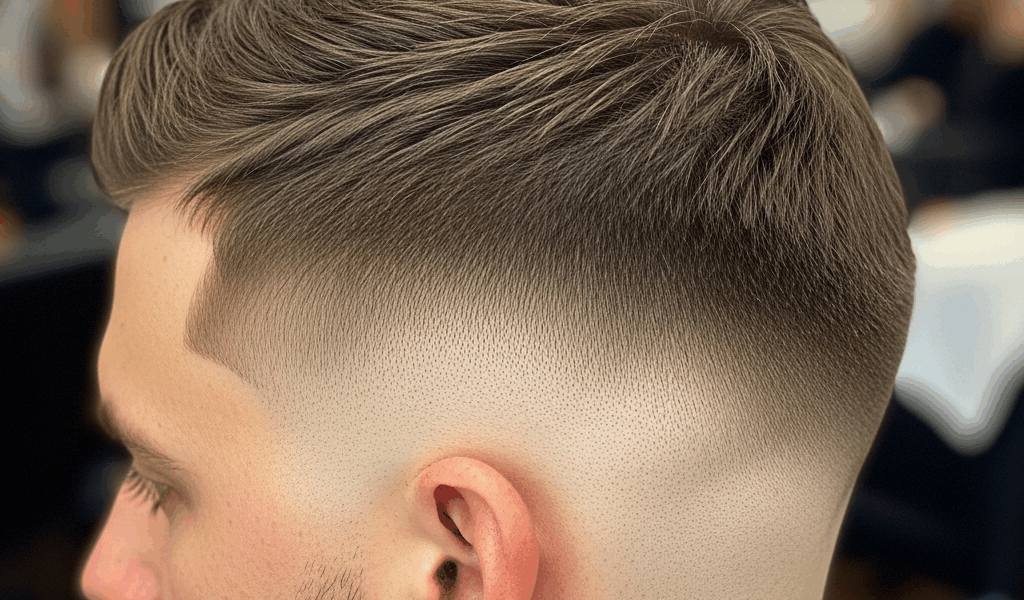
The Textured Crop with Mid-to-High Fade
This is the workhorse. About 1.5 to 2 inches on top, fade starting at the temple line — not below it — blending down to a 0.5 guard on the sides and back.
Texture on top breaks up any perception of thinning. The mid-fade pulls the contrast away from your temples. Your barber isn’t drawing an aggressive line around the recession — they’re building a graduated transition that looks completely intentional. There’s a difference, and it’s visible.
Tell your barber: “Take it to a mid-fade, starting right at the temple, leave me 1.5 to 2 inches on top with texture. I want the fade to blend naturally — no hard line.”
The Buzz Cut with Skin Fade
Half an inch all over, skin fade on the sides. Honest cut. Reads confident rather than like you’re hiding something.
There’s nowhere to hide, so there’s nothing to see. No contrast, no implied missing hair — just uniformity. This works especially well if you’re past temple-only recession. Already noticing crown thinning? This removes the visual problem by removing the differentiation entirely. I’m apparently a skin-fade-works-for-me person, and the buzz cut was the first time I left the barber actually satisfied in years. Wasted about 36 months getting there.
Tell your barber: “Skin fade on the sides, leave me half an inch on top. Uniform — no length variation.”
The Classic Taper Without a Hard Hairline
This one catches people off guard. Looks conservative on the surface. Criminally underrated for recession. Around 2 to 2.5 inches on top, tapered — not faded — sides, and no hard line carved around the front.
The taper is gradual. There’s no border between where the barber stops and where your recession begins — it just dissolves. The length on top carries enough mass to avoid reading as thin, and ditching the defined front hairline removes the focal point that was announcing your temples to everyone in the room.
Tell your barber: “Taper the sides, don’t fade them. Leave the front natural — no defined line. About 2 inches on top.”
The Short Fringe
1 to 1.5 inches on top front, faded sides, intentional texture pushing forward. Redirects the eye from the temples straight to the center of your face.
A fringe sitting lower draws attention downward instead of laterally across your recession. You’re not hiding the temples — you’re making the front of your head visually heavier. Subtle. Genuinely effective.
Tell your barber: “Short fringe, textured, sitting forward. Fade the sides to a 1 guard in back, keep the top shorter up front.”
Cuts to Avoid If Your Hairline Is Receding
Probably should have opened with this section, honestly. These will make your recession more visible, not less.
- The combover — Any cut that sweeps hair across the top to cover thinning underneath. It never works. Everyone sees the thinning. You just add awkwardness on top of it.
- Long top with tight fade — The contrast is brutal. Your barber draws a line ending exactly where your hair isn’t. Hard pass.
- Any cut with a defined front hairline — If your barber is carving a sharp edge around your hairline, recession shows more clearly against it. You need a soft, natural transition — not a border.
- Anything under 0.5 inches on top with significant length in back — Creates ratio problems that read immediately as compensation.
- The long-hair hold — Once recession is visible, length becomes your enemy. The math doesn’t work anymore.
What to Say at the Barber So You Get It Right
- Before you sit: Bring one photo — not a model shot, an actual barbershop photo showing fade height, top length, and texture. Specific reference beats any description.
- When you sit: “My hairline is receding at the temples [and crown / everywhere]. I want a cut that works with that, not against it. No hard lines around the front.”
- Point specifically: Show your barber your actual recession pattern. Don’t be vague. They’ve seen it hundreds of times — they just need to know what they’re working with on your head.
- Ask this: “Where should the fade start to blend with my recession naturally?” A good barber adjusts based on your specific pattern, not a template.
- On length: Say the number. “1.5 inches on top.” Not “short.” Not “a little longer.” Numbers remove ambiguity entirely.
- On texture: “Textured” or “clean.” Skip “messy” or “styled” — your barber knows exactly what the technical terms mean.
You already know your hairline is changing — that part isn’t a surprise anymore. These four cuts work. The scripts are right there. Book the appointment, say the words, and get it right the first time instead of spending three years figuring it out the hard way like I did.


Stay in the loop
Get the latest find my haircut updates delivered to your inbox.