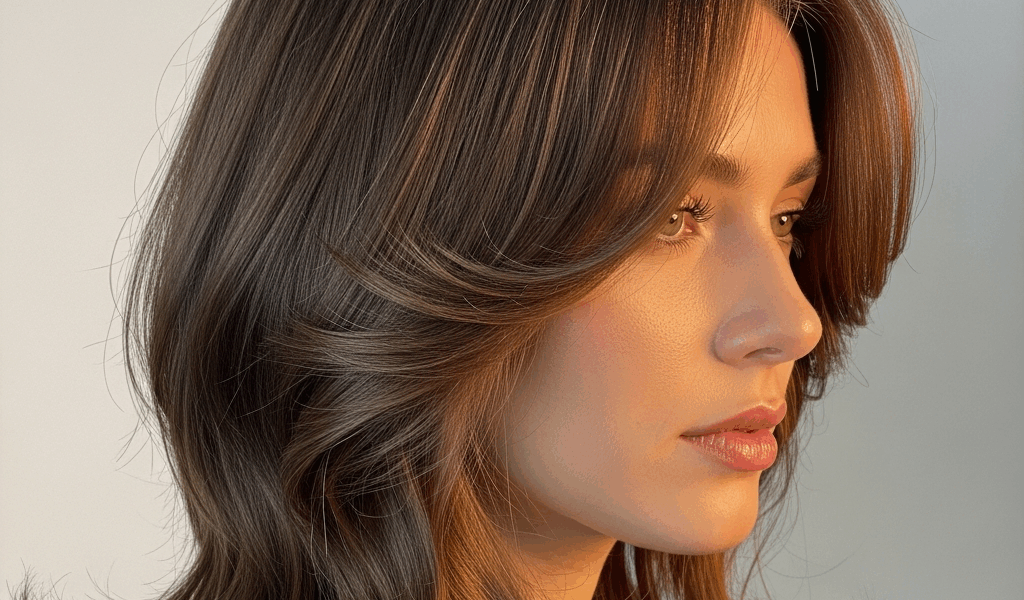
Why Oval Does Not Mean Every Haircut Works
Haircut advice for oval faces has gotten complicated with all the “you can pull off anything” noise flying around. As someone who spent three years cutting hair at a salon on SE Hawthorne in Portland, I learned everything there is to know about how badly that line actually serves people. Today, I will share it all with you.
But what is oval face advice, really? In essence, it’s permission. But it’s much more than that — or it should be. Telling someone with an oval face they can wear any cut is like handing someone a driver’s license and telling them they can go anywhere. Technically accurate. Practically useless without a map.
Yes, oval faces have flexibility that round or square faces simply don’t. You’re not fighting extreme width. You’re not trying to soften a strong jaw. That’s the advantage. But a $180 shag is not going to land the same way on your face as it does on your square-jawed friend who brought in the same Instagram photo. Hair texture, density, and your specific oval dimensions — long and narrow versus short and rounded — determine whether a cut actually flatters you or just sits there looking fine. Fine is not good. Fine is what you tolerate until it grows out.
Figure Out Your Specific Oval Proportions First
Probably should have opened with this section, honestly. Before you fall down a Pinterest rabbit hole, stand in front of your bathroom mirror with your hair pulled back and look at three things.
- Forehead width versus cheekbone width. Is your forehead narrower, wider, or roughly equal to your cheekbones? Use your fingers as a rough gauge — nothing fancy required. A cut that builds volume at the temples reads completely differently depending on whether you’re already balanced through the cheeks or already carrying width there.
- Hairline shape. Straight across, rounded, or widow’s peak? This is the detail most people skip and then regret. A widow’s peak changes everything about how a center part or a set of bangs will actually fall on your face. Don’t make my mistake — I ignored this for months and wondered why certain cuts just looked off on certain clients.
- Face length. Measure from your mid-hairline to your chin. If that number runs noticeably longer than your forehead width, you’ve got a longer oval. Closer to the same measurement? Shorter, rounder oval. That one number determines whether long layers will elongate your face or frame it.
A longer oval with a widow’s peak and a narrow forehead is not the same face as a shorter, rounder oval with a straight hairline and fuller cheeks. Oval is your starting point — everything else builds from there. So, without further ado, let’s dive in.
Which Haircuts Actually Work by Hair Type
Once you know your proportions, match them against your actual hair. That’s where the real decisions happen.
Fine and Straight Hair
Volume matters more than layers here. Too many choppy layers on fine, straight hair read as wispy and thin — I’m apparently a slow learner on this point and a blunt lob works for me as a go-to recommendation while heavily layered shags never quite deliver. A blunt lob ending around chin length, minimal layering, gives you a clean line the hair can actually support. Fine hair can’t generate texture on its own, so the blunt edge does that structural work instead.
A bixie — somewhere between a bob and a pixie, length on top, shorter on the sides — also holds up well here. The tighter proportions make fine hair look denser overall. You do need to be comfortable showing your ear shape and jawline. Worth considering before you commit.
Thick and Straight Hair
Thick, straight hair handles both blunt and layered cuts. The danger is bulk. A shoulder-length cut with two or three long, subtle layers removes weight without turning into a feathered situation. Keep the layers longer at the face — framing, not feathering. A straight-across bang works because the weight actually sits correctly instead of flopping or separating.
Shorter option: a textured crop with length on top. Thick hair has enough substance to hold a shorter shape without going stringy. Sides faded or blended, top kept longer than a traditional crop — roughly 3 to 4 inches — so the whole thing doesn’t read as trying too hard.
Wavy Hair
Wavy hair is where most people mess up. A long shag with lots of choppy layers looks great on wavy hair — unless your oval already runs long. Added movement and length compound the vertical emphasis and suddenly your face looks stretched. A shoulder-length cut with long layers starting below the ear is the smarter move. Your natural wave handles the volume; the cut just gives it a shape to follow. A modern bob with an undercut — shorter underneath, longer on top — also works because you get crown density without added perceived length.
Curly Hair
Curly hair requires a completely different approach. Length reads shorter in curls than in straight hair — a cut that lands mid-length on pin-straight hair might sit several inches higher once your curl pattern kicks in. A shoulder-length cut with layers following your natural curl pattern is the move. Blunt lines fight curls. A textured crop or a longer curly shag — cut specifically for your curl pattern, not approximated — both work because the shape is built into the hair itself rather than imposed on it.
What to Avoid Even With an Oval Face
Knowing what doesn’t work is half the battle — at least if you actually want to walk out looking better than when you walked in.
Too much crown height on a longer oval. Adding volume on top of an already vertically long face creates a lollipop effect. I made this mistake with a client once — fine, straight hair, longer face, she wanted dimension. I cut longer layers with a shorter crown. The proportions read as oversized head, small face. She hated it. Rightfully so.
Blunt bobs landing at your widest point. A blunt line that hits right at cheekbone level can make that width look heavier. Wider cheekbones? Go chin-length or shorter, not at the cheekbone.
Center parts on narrow ovals with narrow foreheads. A center part emphasizes the forehead. On an already-narrow upper face, that imbalance gets worse. A side part — deep works particularly well — is gentler by quite a bit.
Overly long, one-length hair. There’s no shape. Even an oval face that can technically manage any length reads “hasn’t been to a stylist since March” with one-length past the shoulders, not “intentional choice.” It just doesn’t work.
How to Ask for the Right Cut at the Barbershop or Salon
When you book, tell your stylist three things upfront. Not a speech — just information.
First, you should bring two specific reference photos — at least if you actually want the cut you’re picturing. Not vague concepts. Actual images. Point to the length, the layers, the parting. Tell them what you want to replicate and what you’d rather skip.
Second, describe your hair type with specifics. “Fine and straight” or “thick and curly” beats “I want something low-maintenance” every time. Low-maintenance means completely different things at different densities.
Third, mention your face proportions if you’ve measured them. “I have a longer face” or “my forehead is narrower than my cheekbones” gives your stylist actual context. They can adapt the cut to you instead of executing a generic version and hoping it lands. That’s what makes this kind of prep endearing to us stylists — it means someone actually wants a result, not just a haircut. I always respected clients who came in knowing their own faces. Made the whole thing easier for everyone.
You’re not being difficult. You’re doing the diagnostic work ahead of time so the person holding the scissors doesn’t have to guess. That’s not high-maintenance. That’s just smart.


Stay in the loop
Get the latest find my haircut updates delivered to your inbox.