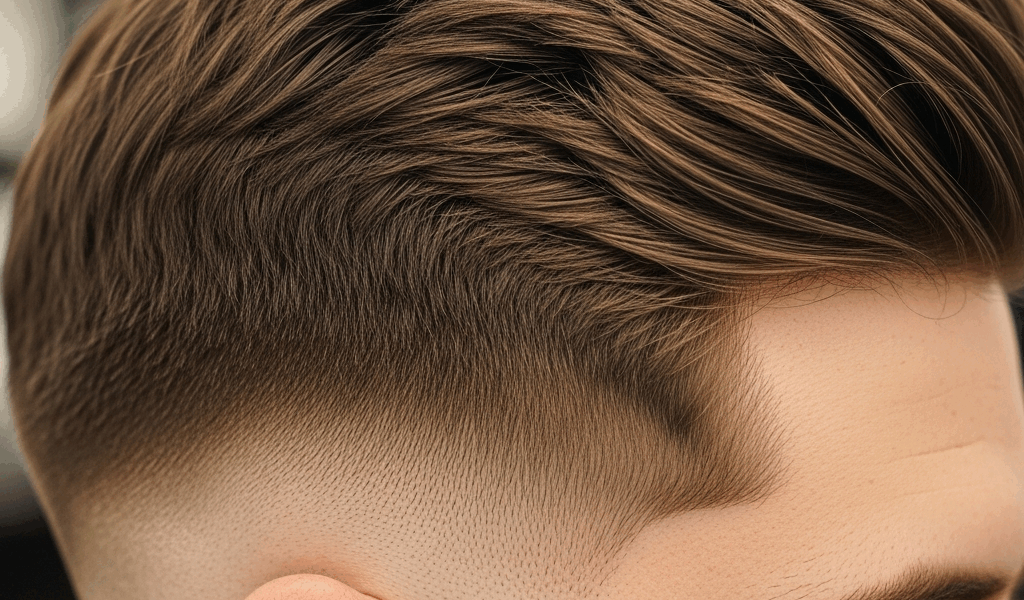
Why Thick Hair Kills a Fade Faster Than Anything Else
Getting a clean fade with thick hair has gotten complicated with all the bad advice flying around. Most guides treat hair like hair — one-size-fits-all. They don’t. I learned that the hard way around age 26, when my hair seemingly changed overnight. My barber looked at me one session like I’d swapped my head out. Same guy, same chair, totally different problem to solve.
So what is thick hair, exactly? In essence, it’s a higher strand density packed into every square inch of your scalp compared to fine or medium hair. But it’s much more than that. It’s a structural problem. The moment those extra strands start growing out — even slightly — they push against each other. Not downward. Sideways and up. The shape goes from sharp to bulbous fast, and no amount of product fixes what’s fundamentally a density issue.
Fine or medium hair holds a fade for 7 to 10 days sometimes. The gradient stays visible because the top doesn’t expand quickly enough to eat the contrast. Thick hair? You’ve got maybe 3 to 4 days before the fade line vanishes into the bulk. That’s not an exaggeration.
Then there’s the weight problem. Thick hair holds actual mass. Leave weight in the top — meaning your barber doesn’t remove density strategically — and that mass pulls outward and downward at the same time. The fade doesn’t gradually fade. The whole cut collapses, like the top is slowly swallowing itself.
Probably should have opened with this section, honestly. The technical problem is what fixes everything else. Tight maintenance schedules help, but they don’t fix a cutting strategy that was wrong from the start.
The Fade Height That Actually Works for Thick Hair
Not every fade survives thick hair equally. A low fade — clippers starting 1 to 1.5 inches above the ear — disappears within days. The density fills in that subtle gradient before you’ve even made it home. You think the fade is gone. It didn’t go anywhere. It blended itself out of existence because there wasn’t enough contrast to survive.
Mid and high fades create the contrast your thickness requires. Mid fades start around 2 to 3 inches above the ear. High fades start right at the temple line. That dramatic drop from skin to hair is your only real defense as thick hair grows in.
But what is the best specific option? In essence, it’s a high skin fade with a hard part. The skin fade takes the sides to bare skin — no guessing where the gradient starts. The hard part, a straight line usually about 1/4 inch wide cut through the hair, gives you a second visual anchor. As your hair grows, both points stay intentional instead of disappearing into fuzz. That’s what makes this combination endearing to us thick-haired guys who’ve watched every other fade fall apart by Wednesday.
If a high fade feels too aggressive for your look, a mid fade with extra transition zone blending works. Tell your barber specifically: “Blend the transition zone extra.” Not just “blend it” — extra. The transition zone is where short meets long, and on thick hair, that zone becomes a fuzzy blob fast without careful attention.
Skin fades on thick hair look clean for roughly 3 to 4 weeks. Taper fades — no skin, just graduated lengths — stretch to about 4 to 5 weeks. Plan around those numbers, not some generic every-three-weeks advice written for guys with fine hair.
What to Tell Your Barber So the Top Does Not Puff Out
Frustrated by a top that ballooned up within hours of leaving the shop, I walked into my barber’s chair one Tuesday morning — place called Proper Cuts on Ashland, $28 for a full fade — and just said it plainly: “Take out the bulk but keep the length.” He put down the guard immediately and picked up his shears differently. That one sentence changed everything.
Point cutting is the technique he used. Scissors held vertically, cutting into the hair rather than across it — creating a textured edge that lets air move through instead of density sitting in one compressed block. Blunt cutting, where scissors run parallel to the floor, creates a solid wall of hair. Point cutting breaks that wall down without touching the length.
Ask for “point cutting on the top” and watch what happens. The length stays. The shape stays. The weight lifts.
Second move: breaking the weight line. If your barber leaves hair blunt at the perimeter — along the hairline or part — that weight concentrates exactly where it causes the most visible problems. A broken weight line means your barber texturizes or point cuts the edges so density disperses instead of creating a heavy outline around your skull.
Use this phrase word for word: “Disconnect the weight line.” Any experienced barber will know what to do with it.
One warning though — avoid thinning shears on coarse hair. Coarse strands have a thicker individual diameter, and thinning shears catch and fray them. The result is frizz and a dull, cotton-like texture. Don’t make my mistake. Point cutting handles bulk better on coarse hair, and so does clipper-over-comb work on the top if you want bulk reduction without scissors at all.
How to Style a Fade When Your Hair Is Thick
I’m apparently a matte clay person — American Crew Fiber works for me while pomade never does anything useful. Pomade adds shine and weight, which is exactly the wrong combination for thick hair. It makes density look bulkier, not controlled. Gel does the same thing, plus it gets crunchy. So, without further ado, let’s just skip both entirely.
Oribe Matte Waves or Layrite Superhold Pomade — despite the name, it runs drier than most — are solid alternatives if Crew Fiber isn’t your thing. Apply to slightly damp hair. Not soaking, not bone dry. Damp hair responds to direction. Dry thick hair has already made its own decisions and isn’t listening to you.
Here’s the move most people skip entirely: blow-dry your hair flat before you apply a single drop of product. Point the dryer downward — toward the scalp — so hair lays down rather than flaring out. Once flat and dry, then apply product and style. You’re building on a compressed base instead of fighting expansion the whole time.
Work product through with your fingers. Not a comb — a comb separates strands and wakes up that outward push. Fingers blend product and keep hair somewhat compressed. Small difference, noticeable result.
How Often to Book a Trim to Keep the Fade Looking Clean
Skin fade or bald fade on thick hair: every 3 to 4 weeks. Taper fade: every 4 to 5 weeks. Those are the realistic numbers for your density — not aspirational, not flexible.
Here’s what most men get wrong. They blame the top when the whole cut starts looking shapeless. The real problem is almost always the sides. Clippered sides grow back into density quietly, and suddenly there’s no contrast anywhere. The cut doesn’t look grown out — it just looks bad, and they can’t identify why.
A sides-only cleanup between full appointments fixes this. Ask your barber: “Can I book a quick sides refresh instead of a full cut?” Most shops charge half price or less for that — I pay $14 at my place versus the usual $28. You stay sharp without cramming every appointment into a six-week death march of bad hair weeks.
Thick hair demands more upkeep — that part is just true. But it’s manageable upkeep once you understand what’s actually happening under the surface. The expansion, the weight distribution, the rapid fade degradation — none of it is random. It all follows the same logic, and once your barber knows what you actually need, the whole thing gets a lot more predictable.




Stay in the loop
Get the latest find my haircut updates delivered to your inbox.