Why Your Last Haircut Made Your Face Look Wider
Getting a haircut for a round face has gotten complicated with all the conflicting advice flying around. “Try a fade.” “No, go longer.” “Just buzz it.” You walk out of the shop feeling decent, then two weeks later you’re staring at photos from that Saturday night thinking — did this cut just make my face look like a dinner plate?
As someone who spent years getting the wrong cuts and finally figured out what was actually happening geometrically, I learned everything there is to know about why certain haircuts betray round faces. Today, I will share it all with you.
The frustration is real. But it’s not mysterious. It comes down to a straight mismatch between what your face needs structurally and what ended up on your head. A round face — where your cheekbone-to-cheekbone width is roughly equal to your forehead-to-chin length — has soft, full cheeks and a jawline without sharp angles. Nothing wrong with that. But it means horizontal lines are actively working against you. When a barber clips too high on the sides, concentrates weight at ear level, or leaves zero variation in length, they’re reinforcing the roundness instead of countering it.
The good news? Cut geometry can flip in your favor just as fast as it can work against you. So, without further ado, let’s dive in — through the exact cuts that actually change how people perceive your face shape, and more importantly, the mechanical reason each one works.
The Cuts That Work and the Geometry Behind Them
The Textured Quiff
This might be the best option for round faces, as this particular shape requires serious vertical emphasis. That is because your face already pulls the eye sideways — you need something that aggressively redirects attention upward.
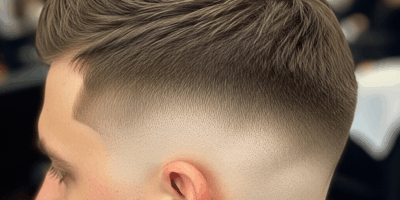
But what is a textured quiff, exactly? In essence, it’s a style with 2 to 3 inches of height on top, kept loose and choppy, with tight faded sides. But it’s much more than that. The texture — created through point-cutting or a clipper-over-comb technique — breaks up solid blocks of hair that would otherwise sit at cheekbone level and highlight width. The fade at the sides, ideally a 0.5 to 1 guard blending down toward the neck, eliminates horizontal bulk entirely.
When you sit down, be specific with your barber: “I want 2.5 to 3 inches on top, textured and choppy — not flat — with a tight fade on the sides blending out by the temple.” That’s it. That’s the whole conversation. Vague requests get vague results.
Mid-Fade with Volume
A mid-fade sits between the temple and the ear. Higher than a low skin fade, lower than a high fade that starts at the crown. Combined with real volume on top, this creates the illusion of a longer face — the fade itself doesn’t draw attention, the height does, and that’s exactly the point.
Probably should have opened with this section, honestly. The mid-fade is more forgiving than a skin fade when your barber is still working on clean blends. The gradual shortening from top to bottom redirects the eye vertically rather than horizontally. Ask for it this way: “Mid-fade on the sides, tight but not skin-tight, and leave me enough length on top to push some height without it looking like a disconnected block.”
Side Part with Taper
Moving the part away from center immediately breaks the symmetrical roundness. That’s what makes the side part endearing to us round-faced guys — it’s doing structural work without looking like it’s trying too hard.
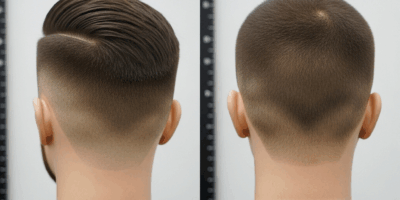
Pair it with a taper rather than a sharp fade. A taper is a longer, more gradual blend — sophisticated without aggressive clipper contrast. Length on top should sit around 2 to 2.5 inches, swept to one side. Your barber will likely comb-direct the hair and finish with scissors-over-comb. The diagonal sweep across the head is the whole game here — it fights the horizontal emphasis that round faces naturally project. The taper keeps sides clean without creating harsh lines that pull the eye outward.
Longer Fringe with Undercut
If you like experimenting, a longer fringe — 3 inches or more — combed slightly forward or off to one side, paired with very short or faded sides, gives you genuine versatility. Style it up when you want height, let it fall forward when you want coverage. I’ve done both depending on whether I was feeling confident about my face that particular morning.
The undercut creates a distinct separation line between the longer top and the clipped sides. That visual separation adds shape where round faces naturally lack it — and the length up top uses shadow and contrast as counterbalance rather than fighting your natural softness.
What to Avoid and Why It Backfires
Skin fades without meaningful length on top leave your full face completely exposed. Nothing interrupts the width visually. Your cheekbones become the focal point — which is already a challenge with a rounder face shape. If the barber takes the sides down to skin and leaves only an inch on top, you’re starting a fight you can’t win.
Buzz cuts are worse. Uniform length across the entire head means no vertical variation, no shadow play, no geometry working in your favor. Just pure horizontal emphasis from every angle. Don’t make my mistake. At 22, I thought a Number 2 all over was clean and low-maintenance. I’m apparently someone with pretty full cheeks, and that buzz made my face look like a softball. I have photos I will never show anyone.
Side-swept styles that move horizontally across the head — think the swoopy, emo-influenced cuts that were everywhere in 2007 — create a line that follows the widest part of your face. More length doesn’t help if it’s all directed across rather than upward. You’re highlighting the problem instead of countering it.
Cuts with weight concentrated at ear or cheekbone level double down on natural width. Some barbers leave heavy sideburns or bulky sections at the sides thinking it reads as masculine. For round faces, it’s just counterproductive geometry. Tight, tapered sides aren’t a feminine choice — they’re a practical one.
How to Talk to Your Barber About This
Don’t walk in and say “make me look less round.” Use language that barbers actually work with day-to-day.
- “I want more length on top to balance my face shape” — signals you understand the concept and aren’t just guessing.
- “Keep the sides tight, either a mid or high fade” — gives them the exact structure to build around.
- “I want texture up top, not just length” — prevents a limp, stringy finish that defeats the entire purpose.
- “Blend the fade by the temple so it doesn’t look disconnected” — shows you care about the finished result, not just the technique in isolation.
Bring a reference photo — at least if you want to skip a round of back-and-forth. But don’t just hand it over and hope. Point to specific elements: “See the height here at the crown” or “Notice the sides are tapered all the way down.” Good barbers genuinely appreciate clients who’ve thought about the reasoning. It makes the appointment collaborative instead of a guessing game on both ends.
Mention your face shape directly if you’re comfortable with it: “I’ve got a rounder face, so I need the sides tight to balance things out.” Most barbers have heard this probably a hundred times. It’s honest, useful information — and it helps them prioritize what actually matters for your specific head.
Styling at Home to Keep the Shape Working
Between cuts, the blow-dry is everything. Dry upward and backward — never flat down. A light matte clay or texture paste — I’ve been using Layrite Superhold Pomade at around $16 a jar for the past year, though honestly American Crew Fiber never quite worked for me the way matte products do — holds height without adding the weight that collapses everything within an hour.
Use your fingers, not a brush. This keeps texture and separation alive throughout the day. A quick blow-dry takes maybe three minutes. Three minutes is the difference between your cut working and your face looking rounder by noon.
One pass upward with your fingers while the hair is still slightly damp. That’s it. You’re set.
Get a fresh cut every 4 to 5 weeks. The geometry only holds while the sides stay tight and the top length stays proportional. Waiting 8 weeks turns a carefully balanced cut into an awkward in-between situation where nothing is doing its job anymore. That’s how you end up back at square one, staring at photos and wondering what went wrong.
The core idea here isn’t complicated. A round face shape haircut that actually flatters isn’t about fighting your features — it’s about using length, taper, and texture to redirect how people’s eyes move across your face. Know which cuts work. Understand why. Walk into any barbershop with that knowledge and you’ll stop leaving disappointed.

Stay in the loop
Get the latest find my haircut updates delivered to your inbox.