Why Cowlicks at the Crown Are Such a Problem
Crown cowlicks have gotten complicated with all the generic haircut advice flying around. As someone who spent three years actively fighting mine before I understood what I was even dealing with, I learned everything there is to know about this specific problem. Today, I will share it all with you.
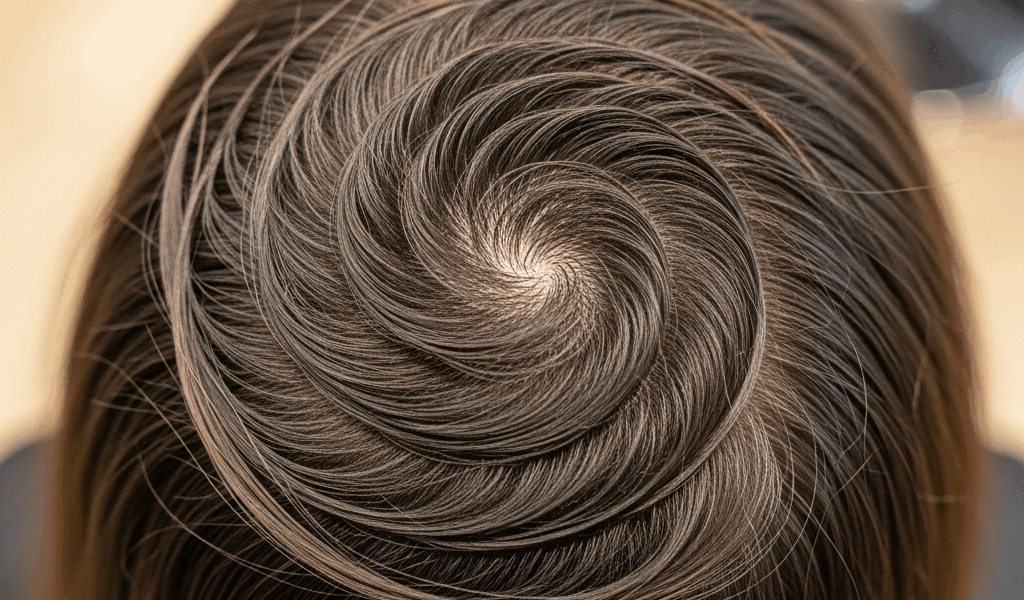
But what is a crown cowlick? In essence, it’s a patch of hair — usually sitting dead center at the top of your head — where the follicles grow in a spiral pattern, almost always counterclockwise. But it’s much more than that. It’s a biological reality baked into your scalp structure. The follicles themselves point in conflicting directions. When you drag a comb through and flatten everything down, you’re not winning. You’re just delaying the inevitable. The hair wins. Every time.
Most generic haircut guides ignore this entirely. They slap a photo of a textured crop or some clean fade next to a list of steps and assume your head cooperates. It doesn’t. A strong crown cowlick turns those recommendations into a morning ritual of staring into a bathroom mirror wondering why a $40 haircut looks chaotic by 9 a.m.
The real fix isn’t a better pomade or sheer stubbornness. It’s choosing a cut that works with your cowlick instead of against it. That’s what makes understanding your growth pattern so endearing to us cowlick-havers. So, without further ado, let’s dive in.
Haircuts That Work With a Crown Cowlick
The Textured Crop
Probably the most forgiving cut for crown cowlicks. Ask your barber for 1.5 to 2 inches on top — kept choppy and disconnected, not blended smooth. The texture is doing the real work here. It breaks up the visual weight of the swirl and makes the cowlick look deliberate rather than accidental.
The longer length gives your hair somewhere to go besides straight up. Choppy texture means individual strands already point in a dozen directions anyway, so your cowlick dissolves into the overall style instead of announcing itself. I’ve worn this cut for two years. Stopped noticing the crown issue within the first week, honestly.
Tell your barber: “I have a strong cowlick at the crown — can you keep the texture rough and avoid blending the top too smooth?”
Short Taper With Length on Top
This cut keeps the sides genuinely short — 0.5 to 1 inch — using a taper fade, then leaves 2 to 3 inches on top. The contrast is the whole point. Your eye goes to the length first. The cowlick direction barely registers.
Skin fade on the sides. Then the barber should use point-cutting or texturizing shears on top rather than scissor-over-comb. You want separation and movement — not a solid block of hair sitting there waiting to reveal a swirl.
While you won’t need extreme length to pull this off, you will need a handful of daily styling minutes. Blow dry the top away from the cowlick and it holds shape for most of the day. The short sides pull visual attention downward and away from the crown almost automatically.
Tell your barber: “Fade the sides down to skin or near-skin, then leave plenty of length on top for texture. I want to style it away from my cowlick.”
The Buzz Cut — When You’re Done Fighting
Clip everything down to a 0.5 or a 1 guard. That’s it. A cowlick becomes invisible at that length. Full stop.
There’s nothing left to swirl. Hair that short stands at roughly the same angle regardless of growth pattern. Your cowlick hasn’t disappeared — it’s still there — but nobody will ever know it exists. I know three guys personally who made this switch specifically because of crown cowlicks. All of them have kept it for years. Low maintenance, zero styling, problem permanently sidestepped.
Don’t dismiss this as quitting. It’s a legitimate style decision.
Longer Messy Fringe
Keep the sides short — 1 to 1.5 inches — and let the top grow out to 3 or 4 inches. Style it forward and off to one side with a textured, undone finish rather than anything slicked or clean.
The length covers the crown area. The intentional messiness means a slightly-wrong swirl reads as part of the design rather than a mistake. First, you should be willing to blow dry and style every morning — at least if you want this cut to actually work. It needs maintenance. But when done right, the cowlick essentially disappears under the falling fringe.
Tell your barber: “Keep it longer on top and shorter on the sides. I want to style it forward and messy, so plenty of texture please.”
Cuts and Styles to Avoid
Slicked-back styles expose your cowlick completely. Smooth wet-look products pull everything tight and make the spiral growth pattern extremely visible — practically a spotlight on the swirl. Skip this entirely if you have a strong crown cowlick.
Hard parts placed anywhere near the crown won’t sit flat. They look crooked regardless of how straight the barber cuts the line. The hair grows outward from the swirl and kills the geometry. No amount of product fixes it.
Super-short crops under 0.75 inches might seem like a logical middle ground, but some guys find the cowlick still shows as a slightly raised patch at that length. Test it before committing. Don’t make my mistake — I held that length for six weeks convinced it would settle down. It didn’t.
How to Tell Your Barber About Your Cowlick
Probably should have opened with this section, honestly. Most of the frustration comes from not knowing how to describe the problem out loud to another human being standing behind you with scissors.
Use these exact phrases:
- “I have a strong cowlick at the crown. The hair grows in a spiral, usually counterclockwise.”
- “Can we leave more length on top so the cowlick has somewhere to go instead of standing straight up?”
- “I want texture and separation rather than a smooth, blended top — that way the swirl blends into the overall style.”
- “The cowlick makes hard parts and slicked-back styles sit crooked. Let’s avoid those.”
Bring your phone. Show an actual photo of a haircut you want — point to the cut itself, not just the vibe. Then mention the cowlick and ask whether your barber thinks it’ll realistically work with your growth pattern. A good barber will tell you the truth. A great one will suggest something better than what you came in with.
Styling Tips That Stop the Cowlick Sticking Up
Blow dry your hair in the direction it naturally wants to grow first. I know that sounds completely backward. But blow drying the cowlick straight up or against the grain basically locks it into its worst position. Dry it with the growth pattern first, then restyle once the hair is mostly set. That sequence matters more than people realize.
Paste or matte clay with medium hold — not pomade, not gel. Pomade is too slick and doesn’t grip actual hair texture. I’m apparently a matte-clay person and American Crew Fiber works for me while gel never held anything properly. Blind Barber 90 Proof Clay is another solid option. Both are under $20. Both grip texture without the shiny wet look that highlights every flaw.
Apply product to dry hair, not wet. Product on wet hair slides around and anchors nothing. Dry the hair completely, work the product in, then shape. That order is non-negotiable.
With the right cut, the right clay, and the right drying sequence, the cowlick stops being a daily argument. It just becomes part of how your hair sits.



Stay in the loop
Get the latest find my haircut updates delivered to your inbox.