Why Most Men Walk Out with the Wrong Fade
Getting a fade has gotten complicated with all the vague barbershop language flying around. You sit down in the chair, clippers already humming, and completely blank on how to describe what you actually want. So you say something like “just fade it” and hope for the best.
Sometimes it lands. Mostly it doesn’t — too short on the sides, a weird blend, a neckline that looks off. You leave unsatisfied but can’t quite explain why.
Here’s the real problem: barbers see hundreds of heads a month. Without specific language from you, they’re making educated guesses. Their preferences, not yours. The gap between what you want and what you’re actually saying out loud — that’s where everything falls apart. Today, I will share exactly what to say. Not vague style names. The specific words and numbers barbers actually respond to.
The Four Things You Need to Decide Before You Sit Down
Every fade comes down to four decisions. Make them before you’re in the chair and the whole conversation becomes almost stupidly easy.
Fade Height — Where It Stops
This is the first thing any barber wants to know. A fade doesn’t run the same length up the entire side of your head — it starts nearly bare at the bottom and gradually gets longer climbing toward the top.
The question is: how far up does that transition go?
- Low fade — The short section covers roughly the bottom half-inch to an inch. The blend happens fast. You keep more length on the sides overall.
- Mid fade — The short part runs from the bottom up to about the middle of your ear. Most balanced option. Most popular for a reason.
- High fade — The bare section climbs all the way to the temple or beyond. Dramatic contrast. Sharp, intentional look.
Pick one word. “Low,” “mid,” or “high.” That single word defines everything that follows.
Skin Fade or Blended
But what is the difference between these two? In essence, it’s how bare the barber goes at the very bottom of the fade. But it’s much more than that — it changes the entire feel of the cut.
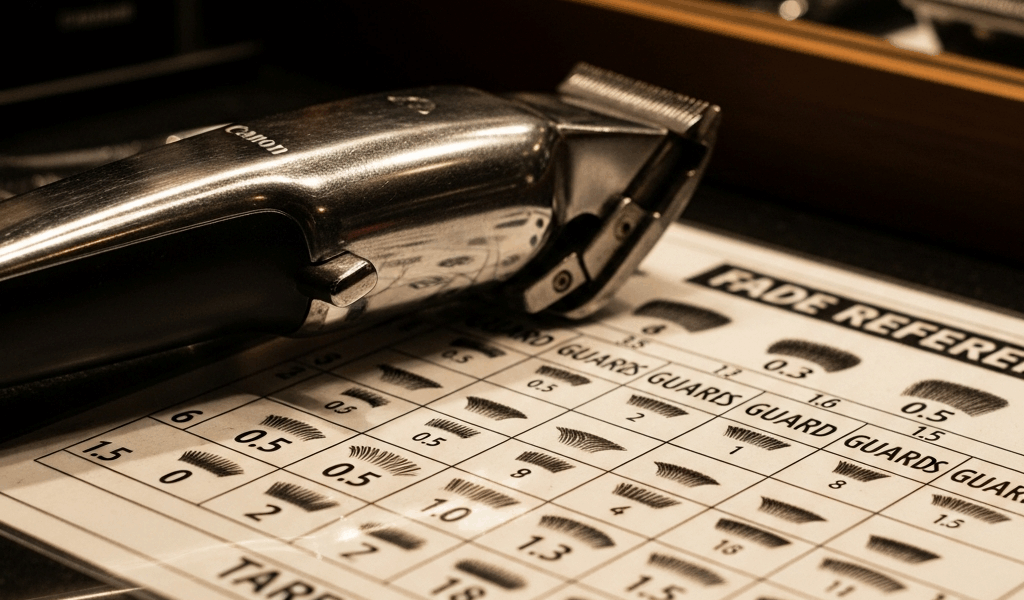
A skin fade means clippers running with no guard — sometimes a 0.5 — taking you literally down to scalp at the lowest point. Clean. Sharp. Very visible. A blended fade, sometimes called a shadow fade, leaves maybe a quarter-inch of stubble at the bottom. Softer. Subtler. Less jarring growing out.
Barbers sometimes use “skin fade” and “regular fade” interchangeably depending on who trained them and where. Knowing which one you want skips the five-minute clarification loop entirely.
Length on Top — Your Working Space
Probably should have mentioned this earlier, honestly. The fade only covers your sides and back. The top is a completely separate decision.
Think in inches. “A little shorter” means absolutely nothing. “An inch and a half on top” means something specific.
- One inch or less — Short, clean, barely any maintenance. Works well for textured crops or anything with military-adjacent structure.
- One to two inches — The range where most men land. Flexible enough to style or just leave alone.
- Two to three inches — You’re committing to product and a comb. Enough to work with but you’ll notice it on bad hair days.
- Three inches or more — You want length on purpose. Wash it regularly and style it deliberately or it’ll look unfinished.
Practice the number out loud before you walk in. “Mid fade, two inches on top.” Takes about half a second to say and sounds completely intentional.
The Finish — Neckline Shape
Last decision. How does the fade end at your neck — gradual taper that follows your natural hairline, or a hard squared edge?
A tapered neckline is the default and works for nearly everyone. Follows the natural curve of your neck. A squared neckline is defined, modern, intentional-looking — but it also means every time you glance at the back of your head in a mirror, you’ll immediately see when it needs a cleanup. Growing out, a squared line can start looking messy around week three. A taper just looks like slightly longer hair.
Don’t make my mistake of asking for a squared neckline without accounting for how fast your neck hair grows. I was back in that chair within 18 days. That gets expensive.
Exactly What to Say — Word for Word
So, without further ado, let’s dive in. You know the four variables now. Here are three complete scripts for different situations — use them verbatim if you want.
The Clean Short Look
“I want a high fade, skin on the sides, with about half an inch on top. Keep the neckline tapered.”
Sharp and low-maintenance. The high fade creates serious contrast. Skin at the bottom looks crisp. Half an inch on top is essentially wash-and-go — at least if you’re not doing anything complicated with product. Tapered neckline keeps it clean without going full military.
The Versatile Length
“I’m looking for a mid fade, blended on the sides, and about two inches on top. Squared neckline.”
Mid fade might be the best option for most guys, as this style requires a balance between contrast and wearability. That is because it sits right in the middle — not dramatic, not boring. Blended keeps it subtle. Two inches on top handles product well or wears naturally textured.
The Subtle Change
“Give me a low fade, no skin, just an inch on top. Can you taper the neckline?”
Works well if you want something less drastic. Low fade keeps most of your side length intact. No skin means soft at the bottom. An inch on top is really more of a shape-up than a cut. That’s what makes the low fade endearing to us guys who aren’t ready to commit to something dramatic.
Grab the script closest to what you want. Adjust the numbers. Done. You sound like you’ve been doing this for years.
How to Use a Photo Without Making It Awkward
Words work fine. A photo works better. And it isn’t awkward — barbers genuinely prefer it.
Find a reference image of someone with similar hair texture and density to yours. Curly hair and a photo of a straight-haired guy creates real confusion. Match the base as closely as you can. Instagram works. Google Images works. TikTok screenshots work. Save three or four options so you’re not locked into a single vision.
When you show the photo, don’t just say “I want this.” Point to specific details. “I like how short it is on the sides here” or “See how the top has that texture? That’s what I’m going for.” You’re starting a conversation — not issuing a command.
If the barber says something won’t work with your hair, listen. He’s not being difficult. He knows your hair in the next twenty minutes better than you do right now.
What to Do If It Starts Going Wrong
Five minutes in and it’s shorter than you asked for. The fade line is climbing higher than you wanted. Do not sit there quietly.
Stop him. Calmly. Use this: “Can we pause for a second? I think I need a little more length on top” or “The fade might be going higher than I wanted — can we adjust?”
You’re not attacking his skill. You’re correcting course early — at least if you want a haircut you’ll actually like. Once the hair is gone, it’s gone. I’m apparently someone who freezes in the chair and says nothing, and that strategy never works for me. Don’t make my mistake.
Good barbers want the feedback. They’d rather fix it now than have you leave frustrated and quietly never come back. Speak up early. It’s the whole difference.



Stay in the loop
Get the latest find my haircut updates delivered to your inbox.