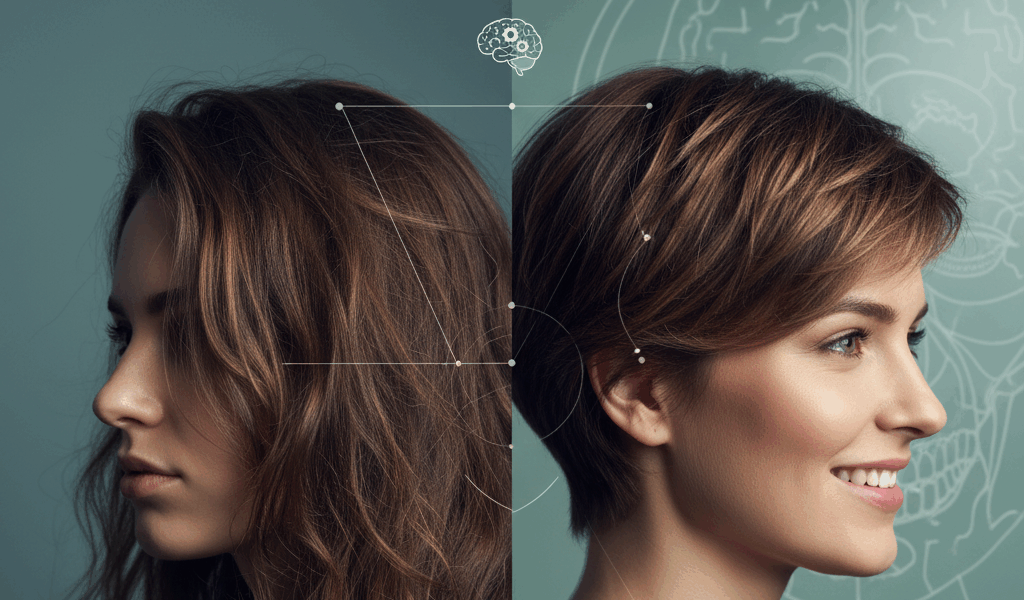
The science of how haircuts change your face has gotten complicated with all the conflicting information flying around. As someone who spent years studying faces from three feet away while holding clippers, I learned everything there is to know about why a simple cut can transform how you look. Today, I will share it all with you.
Every single day in the shop, I watch it happen. A guy sits down looking one way, and twenty minutes later he looks like a different person. Same eyes, same nose, same jaw. Different haircut. Completely different impression. It used to blow my mind. Now I understand exactly why it works.

Your Brain Is Obsessed With Faces
Here’s something wild — your brain dedicates a ridiculous amount of processing power to faces. There’s literally a dedicated region for it. And here’s the kicker: you don’t see faces as a collection of parts. You see them as one whole thing. Change any piece and the entire perception shifts.
Hair is the frame. It determines the canvas your features sit on. A wider silhouette makes your face look narrower. Height on top elongates it. Fringe shortens your forehead. These aren’t tricks or illusions — they’re genuine changes in how people perceive your face. Your features haven’t moved, but the frame around them did.
The Proportion Game
Probably should have led with this section, honestly. Researchers have studied facial proportions for centuries. Your face divides into three roughly equal sections: forehead to eyebrows, eyebrows to the base of your nose, nose to chin. When those thirds are balanced, people read the face as more attractive. It’s not subjective — it’s been measured and tested across cultures.
Now here’s where haircuts come in. Bangs shorten that top third. Volume on top stretches it. Width at the sides changes your face’s width-to-height ratio entirely. When I’m consulting with a client, I’m basically doing proportion math in my head. Where do we need more visual weight? Where do we need less? The answer determines the cut.
Symmetry and How Hair Fixes It
Nobody’s face is perfectly symmetrical. I’ve looked at thousands of faces close-up, and every single one has imbalances. One eyebrow sits slightly higher. The jawline is a touch wider on one side. A nostril is slightly different.
Hair compensates for all of that. More volume on one side offsets a slightly uneven jaw. A strategic part draws attention away from asymmetries. I had a client with a noticeably uneven forehead — a diagonal part created visual balance that made the difference disappear. He had no idea his face was uneven until I pointed it out, and by then I’d already fixed it with the cut.
Angular faces benefit from softer hair that introduces curves. Round faces benefit from more structured styles that add definition. Your hair counterbalances whatever your face is doing on its own.
Where People Actually Look
Eye-tracking studies are fascinating for barbers. They show exactly where people focus when they look at your face. And certain haircuts direct that attention like a spotlight.
Face-framing layers guide eyes straight to yours. Dramatic bangs command attention to the upper face. This means haircuts can genuinely de-emphasize features you’re not thrilled about by pulling attention somewhere else. A strong jaw becomes less dominant when the eyes are drawn upward. A larger forehead fades when face-framing pieces steal focus.
That’s what makes this science endearing to us barbers — we’re basically directing a movie every time we pick up the shears. The star of the show is your best features, and the supporting cast stays in the background.
The Power of First Impressions
First impressions happen in milliseconds. Literally. Before anyone registers your eye color or the shape of your mouth, they’ve processed your overall head silhouette. Hair is a massive part of that silhouette.
This is why fresh haircuts hit so hard. The change registers at that silhouette level — the very first thing brains process. People might not be able to pinpoint what’s different about you, but they know something changed. They say “you look great” without knowing why. It’s because your silhouette shifted.
The Biology Behind It
From an evolutionary standpoint, healthy hair has always signaled good genes and adequate resources. Thick, shiny hair suggests vitality and youth. We’re biologically wired to notice hair quality whether we realize it or not.
So when someone looks more attractive after a good haircut, it’s not just vanity at play. It’s biological signaling. A well-cut style optimizes what your hair is communicating to every person who sees you. Your barber is basically your marketing team.
What Your Hair Says Before You Speak
Beyond the biology, hair communicates social information. Certain styles signal professionalism. Others signal rebellion, creativity, or tradition. These associations are cultural and learned, but they’re incredibly powerful.
Change your style dramatically and you shift how people perceive your personality before you open your mouth. The conservative cut suggests conservative thinking. The edgy style suggests you take risks. Right or wrong, these snap judgments happen automatically in every interaction.
I’ve watched clients change nothing about their lives except their haircut and get treated differently by coworkers, by strangers, by their own families. The same person, the same personality, but a new frame around their face rewrites the introduction.
Using This Knowledge
Here’s the practical part. Now that you know WHY haircuts matter, you can make smarter choices about yours.
Think about what you want to communicate. What features do you want front and center? What do you want to downplay? Share this with your barber or stylist. We love clients who can articulate this stuff because it makes our job more precise.
Don’t fight your natural features. Use hair to complement them. Strong features? Balance with softer hair. Delicate features? Hair can add the structure you need. The goal is harmony, not conflict.
And remember this: changes at the silhouette level make the biggest impact. A dramatically different shape registers way more than a subtle tweak within the same shape. If you want a transformation, change the silhouette. If you want a refresh, refine what’s already working.
The perfect haircut doesn’t exist in a vacuum. It’s specifically perfect for YOUR face, YOUR features, and the message you want to send about yourself. That’s the science, and that’s what makes every cut different.