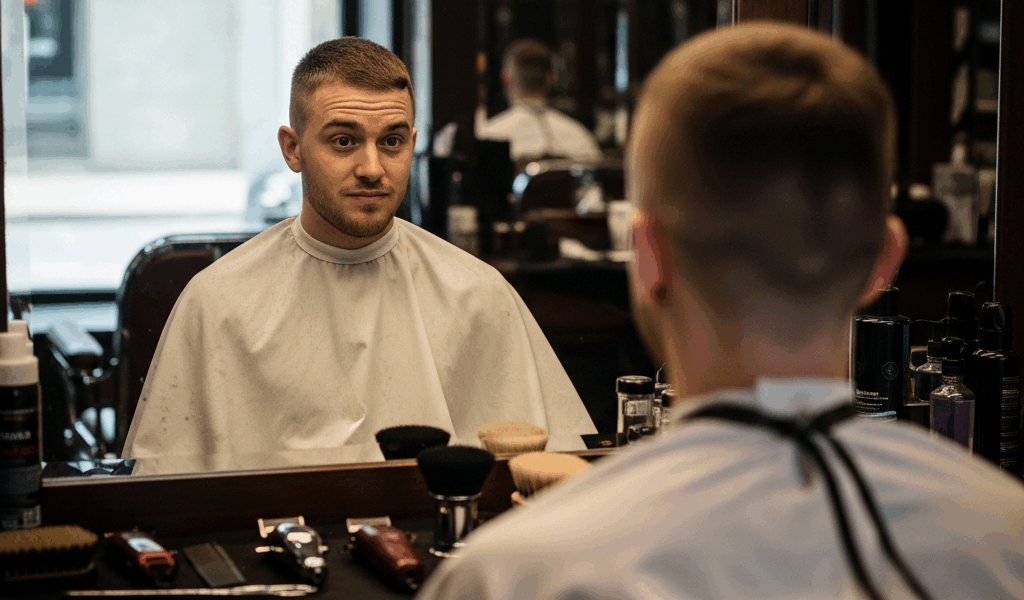
You buzzed it all off. Maybe it was impulsive, maybe it was intentional, but either way you are three weeks in and your head looks like a tennis ball. The good news is that growing out a buzz cut is a straight line from here to wherever you want to end up. The bad news is that months two through four are going to test your patience. Here is what to expect at each stage and what to tell your barber to keep things looking intentional instead of abandoned.
Month 1 — The Fuzzy Phase
Your hair is somewhere between half an inch and one inch long. It sticks straight up everywhere because it is not heavy enough to lie flat yet. This is actually the easiest phase to manage because it looks like a deliberate short cut, not an awkward grow-out.
Do not visit the barber yet unless the back and sides are growing faster than the top and creating a visible imbalance. If that happens — and it often does because hair at the neckline tends to grow faster — ask your barber to clean up the neckline and around the ears. Nothing else. Tell them: “I am growing it out. Just clean the edges.”
Product at this stage is optional. If the fuzz is bothering you, a tiny amount of light-hold pomade can give it some direction. Nothing heavy — at this length, product just makes your head look greasy.
Months 2-3 — The Awkward In-Between
This is where most people give up and buzz it again. Your hair is 1 to 2 inches long, too short to style in any meaningful way and too long to look clean. The sides are puffing out, the top is doing whatever it wants, and you look slightly different every morning depending on how you slept.
The critical move here is barber visits every three to four weeks. This seems counterintuitive — you are trying to grow it, so why keep cutting? Because you are not cutting everything. You are sculpting the grow-out. Tell your barber: “Blend the sides and clean up the ears and neck. Do not touch the top. I need all the length up there.”
What the barber is doing: tapering the sides so they do not mushroom out while the top catches up. Without these maintenance trims, your head goes round and puffy. With them, you maintain a shape that looks intentional even during the messiest phase of the grow-out.
A matte styling clay starts earning its keep around month two. Work a pea-sized amount through damp hair and push it in whatever direction feels natural. You are not creating a style yet — you are just preventing chaos. A baseball cap is also a perfectly valid styling tool during this phase. No judgment.
Months 4-6 — It Finally Lies Flat
Somewhere around month four, you wake up and your hair is lying down instead of sticking up. This is the turning point. You now have 2 to 4 inches on top, which is enough to part, push back, or texture with product. The awkward phase is officially behind you.
Barber visits shift from damage control to shaping. Tell your barber: “I want to start building toward [target style]. Keep taking the sides down but leave length on top and start shaping.” If you are growing toward a side part, your barber can start establishing the part line. If you want a textured look, they can add layers that create movement as the length increases.
Introduce a blow dryer if you have not already. Towel-drying and air-drying at this length leads to flat, formless hair. A blow dryer on medium heat, directed up and back from the front, adds volume and trains your hair to fall in the direction you want. Three minutes with a dryer saves ten minutes of fighting with product.
Product options expand: styling cream for a natural look, clay for texture and hold, or a lightweight pomade for slicked-back styles. Experiment during this phase — your hair is long enough to respond to different products but short enough that a bad product day washes out easily.
Months 6-12 — Real Styles Open Up
At six months you have 4 to 6 inches on top, and genuine hairstyle territory begins. Quiffs, side parts, slick backs, textured crops with length — everything that was impossible at month two is now on the table. Your barber can start giving you a real haircut instead of a grow-out maintenance trim.
Schedule trims every five to six weeks during this phase. The goal shifts from “preserve length at all costs” to “maintain a shape that I actually want to wear.” If your target style is a medium-length textured look, you are essentially there. If you are growing toward something longer — shoulder-length or beyond — you are halfway there and the path forward is straightforward: regular trims to prevent split ends and maintain shape, with a blow dryer and product as your daily tools.
By month twelve, you have 8 to 12 inches depending on your hair growth rate and texture. Curly hair will look shorter than straight hair at the same actual length because of the curl pattern. At this point the grow-out is complete and you are in normal haircut maintenance mode — visiting your barber to refine a style rather than to manage an in-progress transformation.
What to Tell Your Barber at Each Stage
The single most useful thing you can do during a grow-out is communicate clearly with your barber. Here are the exact scripts for each phase:
Month 1: “I just buzzed it and I am growing it out. Just clean the neckline and ears. Do not take anything off the top.”
Month 2-3: “I am in the awkward phase. Blend the sides so they do not puff out, clean the ears and neck, but leave all the length on top. I need it to keep growing up there.”
Month 4-5: “I want to start shaping it toward [describe your target style or show a photo]. Keep the sides shorter than the top, and start building the shape I want.”
Month 6+: “Here is what I am going for [show reference photo]. Shape it toward this. How much more length do I need before we are there?”
Bring a reference photo from month four onward. Before that, photos are not useful because your hair is too short to match any style. After month four, a photo gives your barber a target to cut toward, which makes every trim more purposeful and gets you to your goal faster.




Stay in the loop
Get the latest find my haircut updates delivered to your inbox.