Crew Cut vs Buzz Cut — Which One Suits You Better
The crew cut vs buzz cut debate has gotten complicated with all the conflicting barbershop advice flying around. As someone who spent the better part of a decade getting this choice completely wrong, I learned everything there is to know about short men’s haircuts — mostly through bad haircuts and worse photos. Today, I will share it all with you.
These two cuts look nearly identical in a thumbnail. In real life, they behave like completely different animals. Getting this wrong means four weeks of growing out something you genuinely hate. So, without further ado, let’s dive in.
What Actually Makes These Two Cuts Different
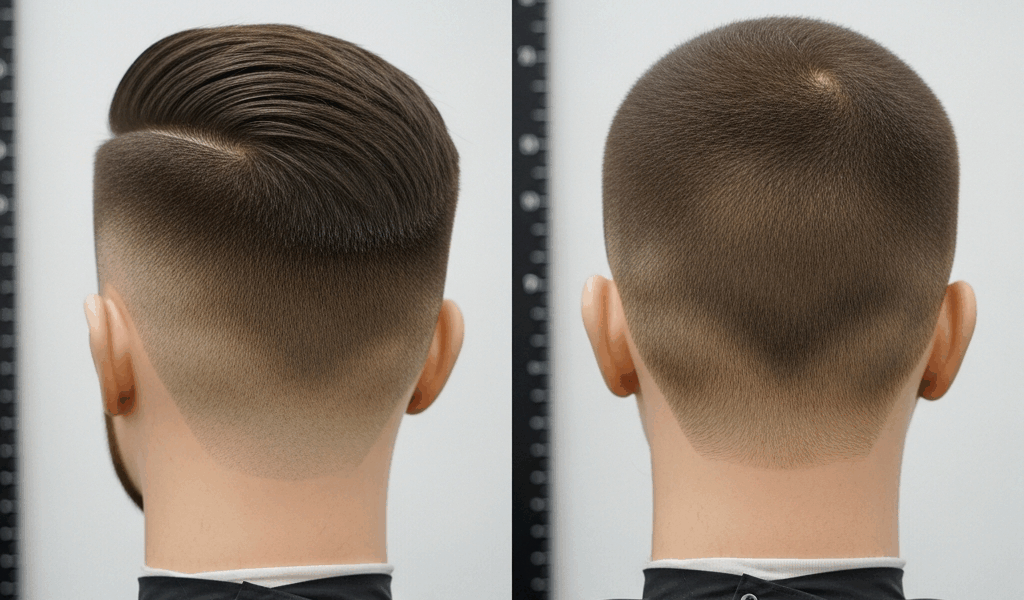
A buzz cut is uniform length — same guard number from your front hairline straight to the back. No fade. No taper. No variation whatsoever. Most guys run a No. 2 (6mm) or No. 3 (10mm) guard, though anything from a No. 1 to a No. 4 still technically qualifies. It’s blunt, consistent, and deliberately uncomplicated.
But what is a crew cut? In essence, it’s a short style that keeps real length on top — typically 1 to 3 inches — paired with tapered, faded sides. But it’s much more than that. The top can be combed forward, texturized, or held lightly with a product like American Crew Fiber or Layrite Superhold. There’s actual structure built into the cut itself.
They are not interchangeable. Calling a crew cut a buzz cut is like calling a taper fade a clean shave. The category overlap only exists at a glance — the execution, the upkeep, and the end result are different in every way that actually matters.
Which Cut Works Better for Your Face Shape
Probably should have opened with this section, honestly. Face shape does more heavy lifting here than most guys realize when they’re sitting down in that chair.
Oval
Lucky you — both cuts work fine. Oval faces carry balanced proportions, so neither style creates obvious problems. The crew cut adds a little height and a polished finish. The buzz cut keeps everything clean and low-effort. Pick based on your maintenance tolerance, not your bone structure.
Round
Go crew cut. Round faces need vertical lines and height to suggest length. The volume a crew cut builds on top does exactly that job. A buzz cut on a round face strips out all the structure and just emphasizes width instead — it flattens everything visually. I kept buzzing my head through my early twenties and genuinely couldn’t figure out why photos never looked right. Don’t make my mistake.
Square
Buzz cut is a strong call here. A square jaw is already doing the work — the buzz cut lets that feature read clearly without competing volume on top crowding it out. A crew cut on a square face can make the whole head look boxy if the sides aren’t faded properly. If you’re square-jawed and still want the crew cut, ask specifically for a high skin fade. It softens the corners enough to make it work.
Oblong
Skip the extra height. An oblong face already runs long — adding more vertical emphasis is the last thing it needs. A buzz cut keeps proportions balanced. A crew cut isn’t completely off the table, but keep the top short and flat. No quiff. No height-forward styling. That’s what makes the buzz cut endearing to us oblong-faced guys — it just doesn’t fight the shape.
How Your Hair Type Changes the Decision
Thick Hair
Both cuts handle thick hair well. The crew cut gives all that thickness somewhere useful to go — it builds texture and body on top that looks genuinely intentional. The buzz cut tames the bulk without showing scalp. Honestly, no major issues either direction if your hair runs thick.
Thin Hair
The buzz cut can betray you here. Uniform short length on thin hair makes the scalp visible — especially under harsh overhead lighting. A No. 3 or No. 4 guard helps push that threshold back, but there’s a point where the math stops working. A crew cut, counterintuitively, can actually look fuller on thin hair. The length on top creates real coverage, and the taper on the sides pulls attention away from density issues near the scalp.
Curly Hair
Curly hair and buzz cuts produce uneven texture when the curl pattern is inconsistent — some patches spring tighter than others, some lie flat. Looks patchy fast. A crew cut on curly hair, though? Genuinely great look once it settles in. Just be ready for the grow-out phase to be messier and faster than straight hair. I’m apparently a 3B curl type and the crew cut works for me while a buzz cut never quite looks intentional. You’ll probably need a trim every three weeks instead of four — budget that in.
Receding Hairline or Thinning Crown
Buzz cut, full stop. Maintaining a crew cut while a hairline recedes creates an awkward situation — the longer top starts reading as damage control instead of a deliberate choice. A buzz cut at a confident No. 2 or No. 3 signals intention. Some of the sharpest-looking guys I know figured this out early and committed completely. That was the right call.
Maintenance — Honest Comparison of Time and Cost
Buzz Cut
This is the DIY cut. A Wahl Magic Clip or Andis Master clippers — around $60–$80 one-time — and you’re doing it yourself at home in ten minutes flat. Realistically, a buzz grows out enough to look shaggy in two to three weeks. So you’re trimming every 14 to 21 days. Annual cost after that initial clipper purchase? Essentially zero.
Crew Cut
You need a barber. The blend between the longer top and the tapered sides requires a trained hand — DIY attempts usually produce a visible line exactly where the fade was supposed to be. A crew cut holds its shape for three to four weeks, sometimes five if it started tight. At a barber charging $30–$45 per visit (standard across most mid-size U.S. cities), you’re looking at $360–$540 per year on monthly visits — more if you’re going every three weeks.
The gap over twelve months is real. Easily $300 to $500 in favor of the buzz cut if you already own clippers. That’s not nothing. Factor it in before you decide.
So Which One Should You Actually Get
Here’s the direct version:
- Zero maintenance budget, receding hairline, or square face — get the buzz cut. Buy the Wahl Magic Clip, run a No. 3 guard, clean it up every two weeks at home.
- Round or oblong face, thin hair, willing to visit a barber monthly — get the crew cut. The structure earns what it costs.
- Curly hair and genuinely unsure — start with the crew cut. The texture on top works in your favor and grows out in a way the buzz cut simply doesn’t.
When you sit down, here’s exactly what to say. For a buzz cut: “All over with a No. 3, tapered slightly at the neckline.” For a crew cut: “Short on the sides with a skin fade up to about here, leave around an inch and a half on top, textured.” Point at the spot on your head where you want the fade to start — that does more work than any terminology you could throw at a barber.
Both cuts are legitimately good. One of them fits your face, your hair type, and your actual schedule. Now you know which one that is.



Stay in the loop
Get the latest find my haircut updates delivered to your inbox.