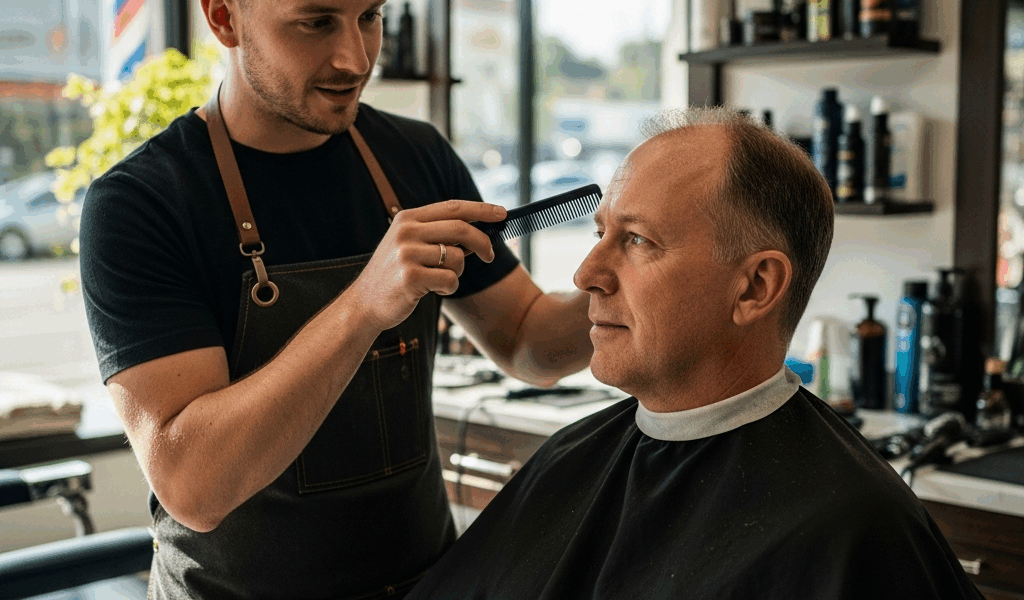
Best Fade Haircut for Thinning Hair — What to Ask Your Barber
If you’re searching for the best fade for thinning hair, you’ve probably already spent twenty minutes staring at photos on Pinterest or Reddit and still have no idea what to actually say when you sit down in the chair. That’s the problem nobody solves. Style articles show you a photo of some guy with perfect cheekbones and a flawless mid fade and say “ask for this.” But they don’t tell you the words. The actual sentence. The thing you say out loud to another human being so you don’t end up leaving the barbershop looking worse than when you walked in. I’ve been in that chair more times than I can count, thinning crown and all, and I’ve made every mistake there is to make — including once just handing my barber my phone with a photo and saying “like this” and walking out looking nothing like the photo. Never again.
This article is about the specific language. The phrases. What you ask for, what you avoid saying, and why certain fades work mechanically on thinning hair while others make the problem more obvious. Let’s get into it.
Why Fades Work for Thinning Hair
Here’s the core principle, and it’s worth understanding before you learn the vocabulary. A fade works on thinning hair because it creates deliberate contrast between the sides and the top. When the sides are tight — buzzed down short, sometimes to the skin — the top of your head reads as having more volume by comparison. Your brain is perceiving relative density, not absolute density. The sides have almost nothing, so whatever you have on top looks substantial.
Think of it like painting a room. Put a pale beige next to bright white and the beige suddenly looks gray. Put that same beige next to a dark charcoal and it looks almost cream. Nothing changed about the beige. Everything changed about the context around it.
That’s what a fade does for thinning hair. It controls the context.
Men with thinning hair often make the mistake of going longer everywhere — keeping length on the sides to “balance” the top, or asking the barber to just trim the ends. This almost always backfires. Long, thin hair on the sides sits flat and wispy. It doesn’t add visual weight. It just emphasizes that the hair is fine and sparse. A fade strips that away and gives you a clean, intentional line that reads as a style choice rather than a surrender to hair loss.
There’s also a practical maintenance element. Short sides don’t require styling. They don’t puff out awkwardly after a night’s sleep or frizz in humidity. The less surface area for thin hair to behave badly, the better the overall cut holds up day to day.
Low Fade — Best for Moderate Thinning
A low fade starts about an inch above the ear and gradually tightens as it moves down toward the neckline. The sides stay relatively longer compared to other fade styles — you might have a number 3 or 4 on the sides just below the temple, tapering down to a 1 or skin near the neck. It’s subtle. Restrained, even.
This is the fade for someone who works in a corporate environment or just prefers a more conservative look. It doesn’t shout. It just cleans things up. If your thinning is moderate — maybe you’re noticing a slightly wider part, some temple recession, hair that used to be thick but now sits thinner — a low fade is probably your entry point.
The low fade is also the most forgiving if your barber misunderstands your instructions. The dramatic contrast isn’t there, so a slight miscommunication doesn’t result in disaster. It’s a good place to start building a relationship with a new barber before you trust them with anything more aggressive.
One thing I learned the hard way — don’t let a low fade grow out more than four weeks without a touch-up. By week five, the taper line blurs, the neck gets scraggly, and the whole point of the cut evaporates. Budget around $25–$35 for a standard barber visit and tip well if they get it right. That relationship is worth money.
Mid Fade — Best for Crown Thinning
The mid fade starts higher — right around the temple level, sometimes just above the ear — and creates a more visible transition line. It’s the sweet spot for a lot of guys with thinning hair because of where it draws the eye.
Here’s the visual redirect that makes it work for crown thinning specifically. When someone looks at you, the mid fade’s transition line is prominent and sits in the middle of the sides of your head. That line is crisp, intentional, and visually interesting. The eye travels to it. The eye stays there. It doesn’t travel upward to the crown where your hair might be sparse or showing scalp. The crown becomes a secondary element, not the focal point.
Probably should have opened with this section, honestly. The mid fade is what I personally wear. I’ve got thinning at the crown — visible in photos taken from above, not a full bald spot but definitely getting there — and the mid fade has been the single biggest improvement I’ve made in managing how my hair looks. I’ve tried the low fade, I’ve tried keeping length everywhere, I’ve tried the Caesar cut. The mid fade with a textured top is the answer for crown thinning, full stop.
The top should be kept at a length that allows for some texture styling — typically 2 to 3 inches. Use a matte clay like Hanz de Fuko Quicksand or American Crew Fiber (about $18–$22 at most drugstores or online) to add separation and create the illusion of density. Shiny pomade is your enemy when hair is thin — it makes individual strands more visible and emphasizes gaps.
High Fade or Skin Fade — Best for Advanced Thinning
A high fade or skin fade is aggressive. The taper starts above the temple, sometimes as high as the parietal ridge — the upper curve of the skull — and fades all the way down to bare skin. Almost no hair on the sides at all.
This works for advanced thinning for a specific reason. When someone is significantly thinning on top — diffuse thinning across the crown, significant recession at the temples, visible scalp through the hair — the comparison problem becomes acute. A mid fade still has some hair on the sides. That hair becomes a reference point. Your brain compares the side density to the top density and registers the difference.
A skin fade removes that reference point entirely. The sides are skin. The top is whatever you’ve got. There’s no density comparison to make. The whole head reads as an intentional style — almost a modern take on the buzz cut — rather than a man losing the battle against hair loss.
Stubbornly avoiding the skin fade when your thinning has progressed significantly is one of the most common mistakes I see. Men hold onto length out of habit or hope. The length isn’t helping. The skin fade, paired with whatever texture you can style on top, looks deliberate and clean. It’s a commitment, but it’s the right one past a certain point.
Getting used to a shorter cycle also matters here. A skin fade looks sharp for about two to three weeks, then the lines start to soften. Budget for more frequent visits — every two to three weeks instead of monthly.
Exactly What to Tell Your Barber
This is the section the whole article is built around. Most guides skip it. Here it is.
First, the most important rule. Never say “just clean it up.” That phrase gives your barber no useful information. “Clean it up” means something different to every barber you’ll ever meet. It’s not a haircut instruction. It’s a feeling. Barbers can’t cut feelings.
Here’s what you say instead, matched to each style:
For a Low Fade
- “I want a low fade — keep the sides around a three or four on top, tapering down to a one near the neck.”
- “Leave about two and a half inches on top, and don’t touch the length — just clean up the shape.”
- “I want to keep it professional. Nothing too dramatic on the sides.”
For a Mid Fade
- “I want a mid fade starting at the temple, going down to a one or skin by the ear.”
- “Keep two to three inches on top. I’ll be texturizing it myself so leave it a little longer than you think.”
- “I have some thinning at the crown — I want the fade line to be the focal point, not the top.”
For a High Fade or Skin Fade
- “I want a high skin fade — starting above the temple, faded to the skin.”
- “Leave whatever length I have on top, but I want a hard line at the top of the fade.”
- “Go short on the sides. I’d rather it be tight than fluffy.”
Frustrated by years of walking out looking slightly wrong, I started writing down exactly what worked each time — specific numbers, specific phrases — and keeping a note on my phone. It sounds obsessive. It works. The number system barbers use (0 through 8, each representing an eighth of an inch of length) is your best friend. A zero is skin. A one is about an eighth of an inch. A four is half an inch. If you use those numbers, you’re speaking the barber’s native language, and the chances of miscommunication drop dramatically.
Also say this: “I have fine hair and I’m thinning at [location — crown, temples, overall]. What would you recommend for the top?” A good barber will have opinions. Let them talk. If they immediately start suggesting techniques or products, that’s a sign they understand the problem. If they just nod and pick up the clippers, you might want a second opinion next time.
One last thing. Bring a photo. Not instead of the verbal instructions — in addition to them. Show the photo, then describe it in numbers and location. “This is roughly what I want — mid fade, see how the line starts here at the temple? I want about a three on the side fading to a one.” Photo plus language is the combination. Photo alone leads to interpretation. Language alone leads to approximation. Together, you have a real shot at getting the cut you actually want.
You’ve got options. The best fade for thinning hair is the one that matches your level of thinning and your willingness to own the look. Start conservative, build trust with your barber, and don’t be afraid to go tighter as the thinning progresses. The fade is on your side.


Stay in the loop
Get the latest find my haircut updates delivered to your inbox.