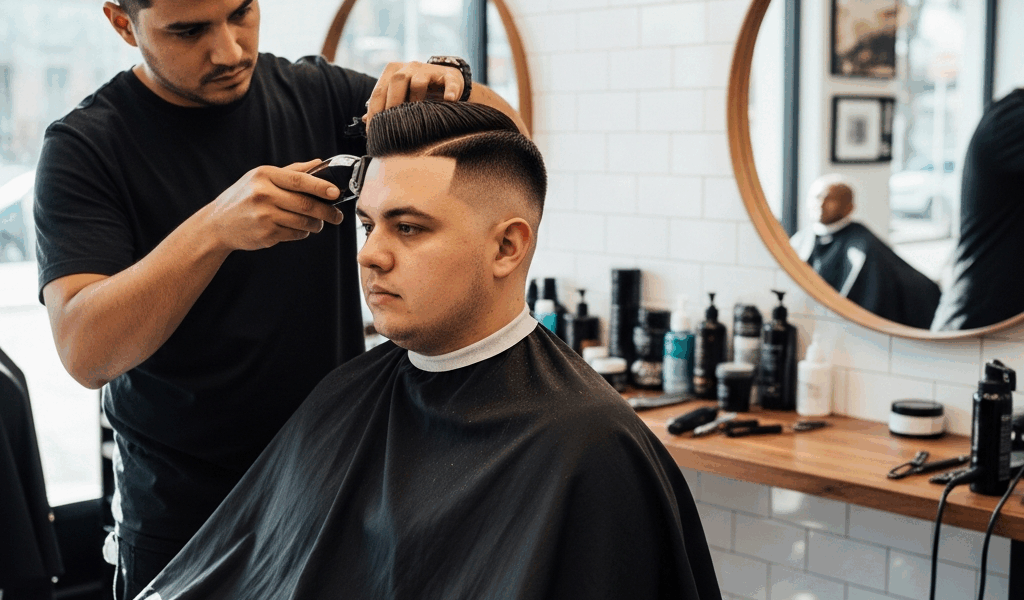
Round faces have roughly equal width and height with soft, curved jawlines and full cheeks. The right haircut adds vertical structure, creates angles that your bone structure does not naturally have, and draws the eye upward rather than outward. The wrong haircut — anything that adds width at the sides or emphasizes the roundness — makes the problem worse.
This article includes affiliate links. We may earn a commission at no extra cost to you.

Here are the cuts that actually work, why they work, and what to tell your barber to get them right.
Why Face Shape Matters for Haircuts
Your face shape determines which proportions a haircut needs to create. Oval faces are balanced and work with almost anything. Square faces have natural angular definition. Round faces need help in one specific area: vertical elongation. The goal is to make the face appear slightly longer and more angular than it naturally is.
Two principles drive every recommendation on this list. First, keep the sides short. Volume at the sides adds width, which is exactly what a round face does not need. Tight fades, tapers, and clean lines at the temples reduce visual width. Second, add height on top. Volume, texture, or length on top creates the vertical proportion that offsets the roundness. Every cut on this list follows those two rules.
High Fade With Textured Top
This is the most versatile option for round faces and the one most barbers will recommend first. The high fade takes the sides down close to the skin from just above the temples, eliminating all visual width in the lower half of the head. The textured top — usually 2 to 3 inches, styled with clay or cream — adds height and movement that draws the eye upward.
It works with straight, wavy, and curly hair. Straight hair gets texture from a matte clay worked through damp hair. Wavy hair already has natural movement and just needs a light product to define it. Curly hair benefits from leaving slightly more length on top to let the curl pattern create its own volume.
Tell your barber: “High skin fade on the sides. Leave 2-3 inches on top. I want texture, not slicked down. I have a round face and I need height.”
Pompadour — Height Changes Everything
The pompadour creates more vertical lift than any other men’s haircut. Hair is swept upward and slightly back from the forehead, adding 2 to 3 inches of visual height above the top of the head. For round faces, this is the most effective way to change the perceived proportions of your face without growing a beard.
The modern pompadour is less extreme than the rockabilly version. You do not need Elvis-level volume. A controlled pompadour with 3 to 4 inches on top, styled with a medium-hold pomade and a blow dryer, adds just enough height to elongate a round face without looking like you are trying too hard.
Pair it with a mid or high fade on the sides. The contrast between the volume on top and the tight sides is what creates the face-slimming effect. A pompadour with full, unfaded sides does not work for round faces — it adds as much width as it does height.
Tell your barber: “I want a modern pompadour. 3-4 inches on top, mid fade on the sides. I need the height to balance my round face. Show me how to blow-dry it.”
Side Part With Taper
Asymmetry is a round face’s friend. A center part emphasizes the natural symmetry of a round face, making it look rounder. A side part breaks that symmetry and creates a diagonal line across the forehead that adds visual length.
The clean part line itself acts as an angular element that a round face does not naturally have. Combined with a taper on the sides — not necessarily a skin fade, just a gradual reduction in length — the side part produces a professional, put-together look that works in both casual and business settings.
This cut needs 3 to 4 inches on top to create a visible part. Use a comb and a lightweight pomade to set the part, and let the longer side fall naturally. The less product you use, the more natural it looks. Over-styling a side part with too much hold makes it look stiff and dated.
Tell your barber: “Side part, left side. Taper the sides and back, keep 3-4 inches on top. I want a clean part line that looks natural, not cemented.”
What to Avoid With a Round Face
Curtain bangs and center parts. These styles emphasize facial symmetry, which is exactly what round faces already have too much of. The center-parted curtain look that works beautifully on oval and oblong faces makes round faces look wider.
Chin-length cuts that frame the cheeks. Any style that adds volume at ear level or below draws attention to the widest part of a round face. If the hair hits the cheekbone or jawline without being pulled back, it adds visual weight where you need less.
Buzz cuts with no variation. A uniform buzz cut that is the same length everywhere removes the ability to create proportional illusions. Without height on top or reduced volume at the sides, a buzz cut simply reveals the face shape as-is. If you have a round face and want a short cut, add a fade — the gradient from skin to length creates the angular transition that a uniform buzz cannot.
Anything that adds width at the temples. Full, unfaded sides that are the same length as the top make a round face look like a circle. The sides must be shorter than the top for any of the recommended cuts to work.
What to Tell Your Barber
Most barbers understand face shapes and can make recommendations if you give them the right information. Here is a simple script that covers what they need to know:
“I have a round face and I want a cut that makes it look longer, not wider. Keep the sides tight — fade or taper, your recommendation. Leave enough length on top for some height. I want to add angles, not emphasize the roundness.”
Then show a reference photo. One specific photo of a haircut you like is worth ten minutes of verbal description. Find a photo of someone with a similar face shape to yours, not just a similar hairstyle — the same cut looks different on different face shapes, and your barber needs to see the full picture to adapt it for your head.
If your barber suggests something different from what you showed, listen. They are looking at your hair texture, density, growth patterns, and head shape from angles you have never seen. A good barber will explain why they are adjusting the plan. A great barber will adjust it and you will not know the difference until you realize it looks better than the photo.



Stay in the loop
Get the latest find my haircut updates delivered to your inbox.